Category Archives: Program Highlights

The Story of India

Episode 2: The Power of Ideas

Thursday, November 19 @ 8:00pm & 11:00pm

The second episode of Michael Wood’s journey through Indian history covers the last centuries BCE—the age of the Buddha, the coming of the Greeks and the rule of the emperor Ashoka, one of the greatest figures in world history.

Beginning with incredible images of a Jain festival that takes place once every twelve years, Wood sees the Buddha as India’s first protester, follows the invasion of India by Alexander the Great and ends with the birth of the first great Indian empire.

The theme of the episode is the power of ideas in Indian history, and among the people Michael Wood meets is His Holiness the Dalai Lama who explains why Buddhism is still relevant today.

Stupa at Kolhua

Stupa at Kolhua, near Vaishali, in Bihar

The journey takes us by railway to the famous sites of the Ganges plain, Benares, Sarnath and Bodhgaya; by helicopter and army convoy through northern Iraq to the site of the greatest battle in the ancient world; by truck up the Khyber Pass, then by river to the first great Indian capital Patna. Using archaeology, living traditions, legends, and “India’s Rosetta stone”, Michael Wood tells the story of the first great Indian state, “the forerunner of today’s India”.

We hear the dramatic story of the first great emperor who renounced his kingship and starved himself to death. Finally we meet his grandson, who after a cruel and violent opening to his reign, renounced warfare and introduced the dangerous idea of non-violence, which runs down through Indian history all the way to Mahatma Gandhi and the Freedom Movement.

Find out more »
MUSTANG

mustang1

JOURNEY OF TRANSFORMATION

THURSDAY, JANUARY 7 @ 8:30PM

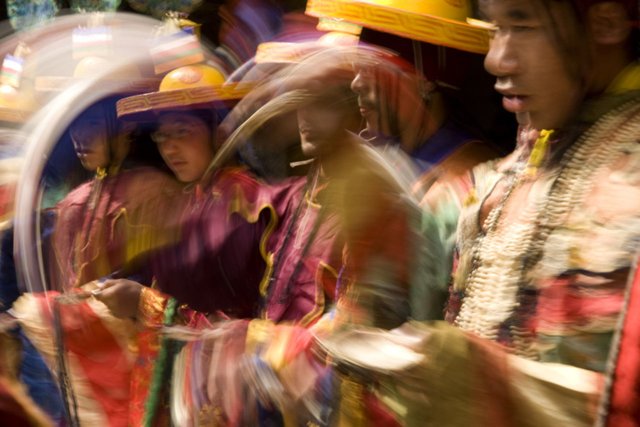
Mustang – Journey of Transformation is a 30-minute documentary that tells the remarkable story of a Tibetan culture pulled back from the brink of extinction through the restoration of its most sacred sites. Narrated by Richard Gere, the film features interviews with His Holiness the Dalai Lama, the King of Mustang, and Luigi Fieni, the chief art conservator of Mustang’s ancient Buddhist masterpieces

The Himalayan Kingdom of Mustang lies on a high and windswept plateau between northwestern Nepal and Tibet in one of the most remote regions in the world. Although Mustang is culturally and ethnically Tibetan, politically it is part of Nepal. At a time when Tibetan culture in Tibet is in danger of disappearing under China’s occupation, Mustang remains uniquely preserved. This starkly beautiful place is home to one of the last surviving repositories of Tibetan sacred art from the 15th century. To travel here is to journey into the past where one can witness ancient Tibetan ways of life.

Surviving the Dust Bowl

Saturday, November 21 @ 7:00pm

In 1931 the rains stopped and the “black blizzards” began. Powerful dust storms carrying millions of tons of stinging, blinding black dirt swept across the Southern Plains—the panhandles of Texas and Oklahoma, western Kansas, and the eastern portions of Colorado and New Mexico. Topsoil that had taken a thousand years per inch to build suddenly blew away in only minutes. One journalist traveling through the devastated region dubbed it the “Dust Bowl.”

Surviving the Dust Bowl is the remarkable story of the determined people who clung to their homes and way of life, enduring drought, dust, disease—even death—for nearly a decade. Less well-known than those who sought refuge in California, typified by the Joad family in John Steinbeck’s “The Grapes of Wrath,” the Dust Bowlers who stayed overcame an almost unbelievable series of calamities and disasters.

Find out more »

Masterpiece Contemporary

Collision

Sunday, November 15 @ 7:00pm & 11:00pm

Point of impact — Friday afternoon on England’s busy A12 highway. Six cars collide in a terrible spectacle leaving two dead. Detective Inspector John Tolin (Douglas Henshall, Primeval) is called in to clean up, and quiet the cries of racism coming from the family of one of the victims. But a methodical investigation only scratches the surface of the ten strangers involved, and the surprising and touching ways they are transformed after the accident. Senior Investigating Officer Ann Stallwood (Kate Ashfield, Poirot), herself entangled with Tolin, joins the inquiry as allegations of corporate crime, infidelity, shameful secrets and murder slowly rise from the wreckage. Written by Anthony Horowitz (Foyle’s War) and Michael A. Walker, Collision investigates human nature, fate and the intriguing ways the truths of our lives are revealed.


Find out more »

Austin City Limits

Willie Nelson & Asleep at the Wheel

November 15 @ 9:00pm

Singer-songwriter author, poet and actor, Willie Nelson rose to national stardom during the outlaw country movement of the 1970s, but has remained both a musical and cultural icon through the decades. Since their inception in 1970, Asleep at the Wheel has won nine Grammy Awards, released more than 20 studio albums and have charted more than 20 singles on Billboard’s country charts. Tonight these country legends grace the Austin City Limits stage performing songs from their newest release, Willie and the Wheel.

The concept of Nelson and Ray Benson’s troop recording classic Western swing tunes together goes back to the early 70s, when Willie was on Atlantic Records and championed by legendary producer/A&R man Jerry Wexler. Willie’s tenure with Atlantic was brief and the project didn’t come together until this decade, when a retired and ill Wexler called Benson to revive the idea. Armed with a stack of old LPs donated from Wexler’s personal collection, complete with the initials “WN” penciled in by certain tracks, the musicians completed Willie and the Wheel in time for Wexler to hear it before he passed on.
“Jerry wanted us to do this album and I’m glad we got to do it for him,” said Nelson.

And critics are also glad they decided to do the CD. Willie and the Wheel takes the musicians back their musical roots, making it “hard to listen to the album and not have a smile on your face.” [Listen.com]

“Nelson sounds like an absolute natural in these environs,” The Washington Post wrote. “Asleep at the Wheel’s take on Western swing should be especially interesting to fans of early 20th-century American popular music. Their fidelity to the source material means that traces of jazz swing, ragtime and Dixieland are preserved as if in amber, sounding much as they did in the 30s and 40s.”


Find out more »

Hoover Dam: American Experience

Saturday, November 14 @ 7:00pm

It has been compared to the Acropolis of Ancient Greece and the Coliseum of Imperial Rome. Rising 726 feet above the raging waters of the Colorado River, it was called by the man whose name it bears “the greatest engineering work of its character ever attempted by the hand of man.” In fact, Hoover Dam reflected the engineering genius and design philosophy of the time. And, in the midst of the Great Depression, it was a symbol of hope for the dispossessed.

Winding through California’s richly fertile Imperial Valley, the Colorado River was wildly unpredictable—flooding in the spring, drying up in the summer. The only way to harness this indispensable resource was to build a dam, which in turn would provide badly needed electricity to the western states. It was a brilliantly conceived scheme, uniting public works and private enterprise. A giant construction company was formed by six previously smalltime contractors.

The engineering problems were stupendous, the solutions ingenious. Before work could start, the river had to be diverted. Four tunnels, each 50 feet in diameter (which today could accommodate a 747 without the wings), were drilled through the solid rock walls of the Black Canyon. Men called “high-scalers,” lowered in bosun’s chairs, stripped the canyon walls of loose rock.

For two years, workers poured concrete 24 hours a day, seven days a week. Working conditions were dangerous, pay was low, housing inadequate. But it was the Depression, and many were grateful to have work. Five thousand men and their families settled in the Nevada desert. There were two mess halls, each seating 600; the dishwasher was sixteen feet long.

The federal government built Boulder City, an efficiently run, well-ordered company town, but dozens of tent cities sprang up—honky-tonk towns dotted the road from the dam to the small town of Las Vegas.

In 1935 the job was finished under budget and ahead of schedule. But Hoover Dam also raised policy questions about the economic and environmental impact of large scale irrigation throughout the West.

Temporarily renamed Boulder Dam by the Roosevelt Administration, the project’s electrical output helped build the ships and planes used in World War II; its water grew fruits and vegetables in California. It tamed a wild river and, for a time, renewed faith in American ingenuity and technology.

Secrets of the Dead

T he A ir men and the Headhunters

Friday, November 13 @ 8:00pm & 11:00pm and Saturday November 14 @ 6:00pm

In 1944, as war raged across the globe, an incredible drama unfolded in the remote jungles of Borneo. A U.S. bomber was hit by Japanese anti-aircraft fire, and as the plane went down, the surviving crew ejected and parachuted into the wilderness. Pursued by Japanese soldiers, they were taken in and protected by members of the Dayak tribe—the so-called “wild men of Borneo,” who were infamous for their grisly custom of hunting and smoking enemy heads. Months later, the airmen were found by an eccentric British Major, who arrived in the jungle to set up a guerilla army, and built a runway out of bamboo so rescue planes could pick up the stranded airmen. Harder to believe than a fictional Hollywood thriller, their true tale is one of courage, survival, and compassion from the most unlikely sources. Based on the book of the same title by Judith Heimann and featuring exclusive testimonies from the last surviving airman, veterans and Dayak heroes, dramatic on-location recreations, archival film footage, and never-before-seen photographs,

The Story of India

Holi Festival
Holi Festival

Thursday, November 12 @ 8:00pm & 11:00pm

Episode 1: Beginnings

The first episode looks at identity and the roots of India’s famous “unity in diversity”. Using all the tools available to the historical detective—from DNA to climate science, oral survivals, ancient manuscripts, archaeology, and exploration of the living cultures of the subcontinent—Michael Wood takes us from the tropical heat of South India to the Ganges plain and from Pakistan and the Khyber Pass out to Turkmenistan where dramatic new archaeological discoveries are changing our view of the migrations that have helped make up Indian identity.

We begin long before recorded history with the first human journey out of Africa. In extraordinary scenes in the tropical backwaters of Kerala, Wood finds survivals of human sounds and rituals from before language.

In Tamil Nadu the latest DNA research takes him to a village where everyone still bears the genetic imprint of those first “beachcombing incomers”—the “first Indians” who went on to populate the rest of the world excluding Africa.
Find out more »

NOVA | Becoming Human

SUNDAY, November 22 @ 5:00pm

Birth of Humanity

NOVA presents a comprehensive three-part, three-hour special-investigating explosive new discoveries that are transforming the picture of how we became human. The first program explores fresh clues about our earliest ancestors in Africa, including the stunningly complete fossil nicknamed “Lucy’s Child.” These three-million-year-old bones from Ethiopia reveal humanity’s oldest and most telltale trait-upright walking rather than a big brain. The second program tackles the mysteries of how our ancestors managed to survive in a savannah teeming with vicious predators, and when and why we first left our African cradle to colonize every corner of the Earth. In the final program, NOVA probes a wave of dramatic new evidence, based partly on cutting-edge DNA analysis, that reveals new insights into how we became the creative and “behaviorally modern” humans of today, and what really happened to the enigmatic Neanderthals who faded into extinction. Shot “in the trenches” as discoveries were unearthed throughout Africa and Europe, each hour of Becoming Human unfolds with a forensic investigation into the life and death of a specific hominid ancestor, such as Lucy’s Child. Dry bones spring back to vivid life with stunning animation, the product of a unique NOVA collaboration between top anthropologists and a talented team of movie animators.

The Berlin Airlift: American Experience

Sunday, 11/08/09 at 8:00pm and 12:00am

Commemorating the 50th anniversary of the end of the Berlin blockade, this program captures the suspense, drama and historical significance of this phenomenal story through newsreels, eyewitness accounts and interviews. The Berlin Airlift of 1948-49 was the most dramatic rescue operation of the 20th century. It not only saved one of Europe’s most important capitals from Communist takeover, but is viewed by historians as the single most significant event in stopping the Soviet advance across Europe.